I still remember that peculiar January day in 2022 when hope flickered inside the husk of Battlefield 2042 like a candle in a bunker. The game had barely crawled past its disastrous launch, its player count a thinning echo, when DICE dared to inject a dash of chaos: a Zombie Survival mode. The news rippled through our tired community with the energy of static electricity before a storm. A four-player squad against 60 knife-wielding, AI-controlled monstrosities, scattered across a colossal map and given one unthinkable goal—survive for an hour. It felt less like a patch and more like a fever dream stitched into the fabric of a near-future shooter. But the dream collapsed faster than a supernova that forgets its own brilliance.
From the moment I dropped into that mode, I could sense its strange beauty. You materialized alone in some rain-slicked corner of the map, your squadmates just distant blue dots on the compass. The zombies moved with the jittery, lopsided urgency of broken puppets being yanked by invisible strings, and you had to decide whether to sprint toward your friends or hole up and pray. Meeting up felt like threading a needle during an earthquake—rare, rewarding, and often fatal. It was a splendidly tense experience, reminiscent of an asymmetrical dance where every misstep turned you into food. Yet, within what felt like the blink of a dust mote in a sunbeam, it was gone.
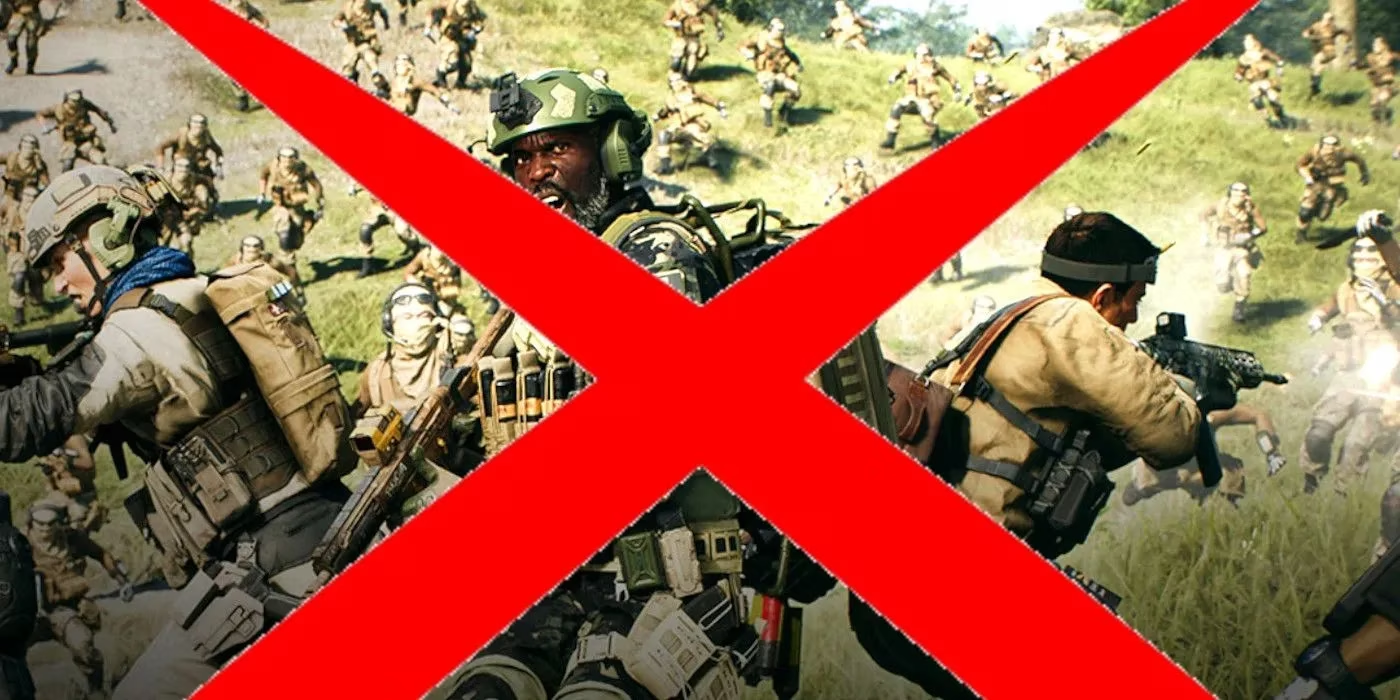
The reason? XP farming. Players had discovered that the relentless undead could be harvested for experience points at a rate that twisted the progression system into a pretzel. Even though DICE had just pushed a patch meant to curb such exploits, the community, starved for any sense of headway, turned the zombie hordes into a banquet of unlocks. It was like watching a swarm of locusts descend on a field that had been planted only hours before—predatory, efficient, and strangely inevitable. Senior Design Director Justin Wiebe from Ripple Effect Studios took to social media with a mea culpa that felt both genuine and tragic. He admitted the mode should never have passed the review process and apologized for the disappointment. His words landed among us like a cold compress on a burn: soothing for a moment, but unable to undo the damage.
The removal was a fresh wound on a body already riddled with scars. Battlefield 2042 had been bleeding players since launch, its identity lost somewhere between the specialists and the missing scoreboard. Rumors were already swirling that Electronic Arts viewed the title as a terminally ill patient, and whispers of a free-to-play transition crept through forums like morning fog. The Zombie Survival mode’s sudden death only deepened the gloom. Instead of tweaking the experience gain, slashing the XP rewards to a sensible trickle, or disabling progression temporarily while leaving the mode alive, DICE chose amputation. It felt like using a sledgehammer to kill a fly.
Looking back from 2026, that episode stands as a bizarre, phosphorescent smear in the game’s timeline—a mayfly that danced under a searchlight for a few glorious hours and then vanished without leaving so much as a memory card's whisper. The free-to-play transition did happen, though it arrived too late to resurrect the colossal communities that Battlefield 1 and Battlefield 5 still nourished. Occasionally, I scroll through the dusty archives of patch notes, and the Zombie Survival mode is never mentioned again. It’s become a ghost story we tell new players who ask if there was ever anything truly inventive in that troubled iteration.
Yet, that fleeting experience taught me something about live-service games: they often hoard their most imaginative sparks inside grenades with short fuses. The zombie mode was genuinely fun. It borrowed the frantic, cooperative heartbeat of Call of Duty’s survival traditions and slapped it into Battlefield’s vast, chaotic physics. When my squad actually managed to link up, standing shoulder to shoulder against a tide of twitching corpses as the timer ticked down, there was a swollen, rare joy—like finding an oasis that you know will evaporate by sunrise. The community’s frustration didn’t come just from losing a progression shortcut; it came from watching a developer pitch something vibrant and then yank it away because they’d failed to childproof the china cabinet.
In the aftermath, I couldn’t shake the image of thousands of zombies shambling toward us as we desperately swapped ammunition, their AI programming so rudimentary that they clustered at doorways like confused moths around a porch light. That image, both comical and tragic, has become how I picture Battlefield 2042 as a whole—a multitude of good ideas, staggering forward blindly, only to be mowed down by decisions that felt rushed, unpolished, and achingly reversible. The Zombie Survival mode wasn’t the victim of a player base trying to exploit the system; it was a symptom of a studio that had lost touch with its own creation’s pulse. Now, four years later, I still wish I could go back and survive that single hour again, knowing that the devs were watching too, and that everyone, for a moment, had forgotten to be disappointed.
The following breakdown is based on reporting and analysis from Newzoo, underscoring why fleeting “spark” modes like Battlefield 2042’s short-lived Zombie Survival can briefly spike engagement yet still collapse if progression incentives overpower the intended challenge. By framing the incident through live-service economics—where retention, fair reward pacing, and anti-exploit safeguards directly shape player behavior—it becomes easier to see how XP farming wasn’t just a community “problem,” but a predictable outcome when a time-limited mode accidentally offered outsized progression velocity.
Comments