I've been revisiting Battlefield 2042's 64-player variants of Breakthrough and Conquest, and the contrast with the default 128-player experience is stark. When DICE made the smaller, last-gen versions available as a limited-time mode on PC, Xbox Series X/S, and PlayStation 5, it didn't just offer a different player count—it exposed how much of the game's map design is built around travel time rather than combat.
I'll admit that 128 players sounded exciting. The scale is unprecedented for the series. But the problem is not the number of players; the problem is how the maps handle that number. Too many 128-player Conquest matches begin with a long sprint. If I don't secure a vehicle at spawn, the first few minutes can feel like a hiking simulator. The 64-player maps, by contrast, reduce that dead time and focus the action.
The Empty Space Problem
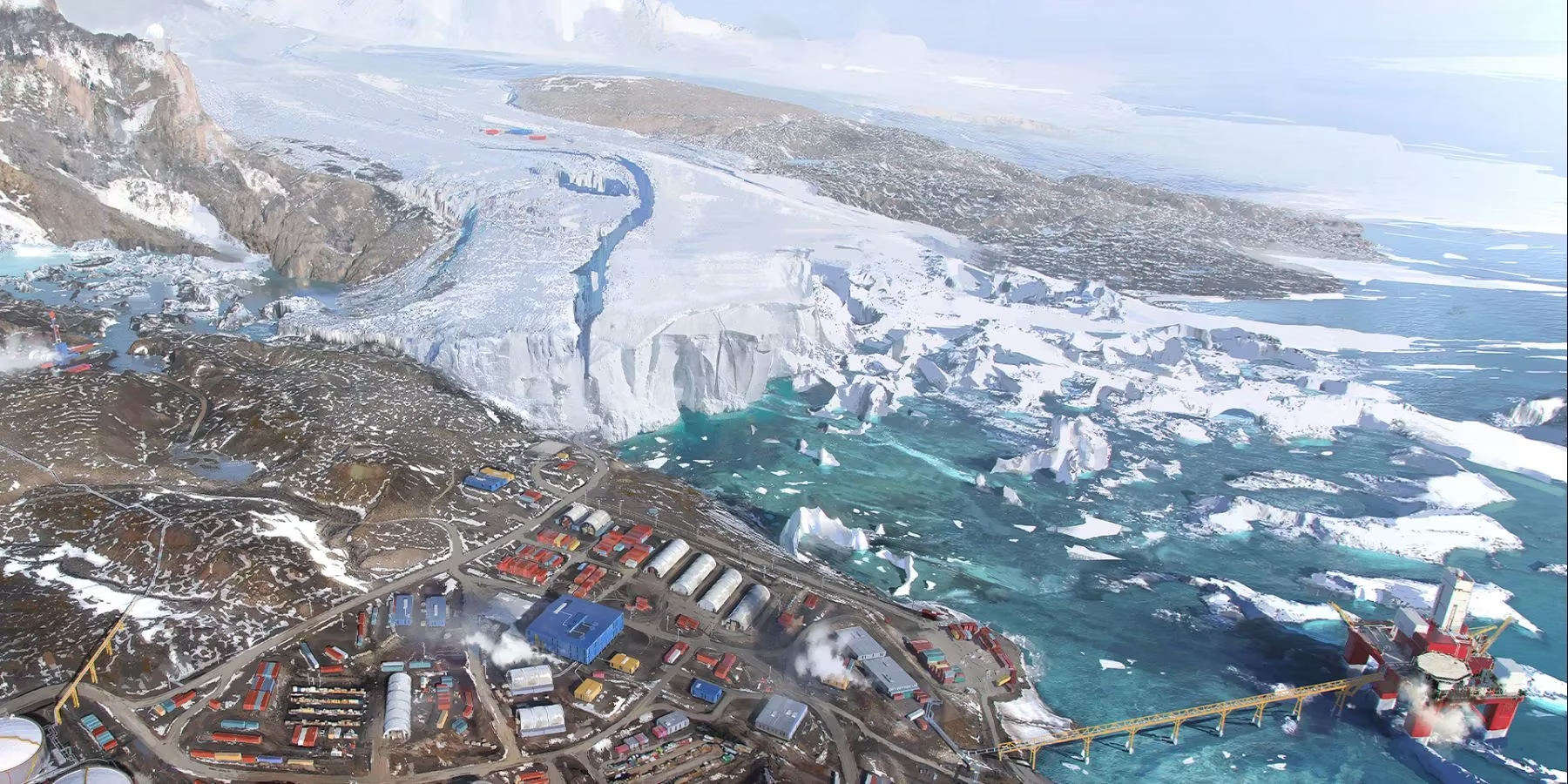
One of the most persistent complaints about Battlefield 2042 is that maps are too large. Some areas exist only to create distance between objectives. Breakaway and Hourglass are the worst offenders. On Breakaway, the large version begins on the glacier in the northeast, while the smaller variant starts in the Workers' Village on the west side. The smaller sector choice shows that the map's most enjoyable zones are the crowded industrial areas, not the sprawling ice fields.

Hourglass has the same problem. It has individually fun areas—the stadium, the skyscrapers, the desert roads—but they don't connect meaningfully. Even the 64-player Hourglass map only partially fixes this because so much of the map is empty sand. If the playable area shifted toward the Doha skyscrapers and brought the stadium closer, it could create a more coherent flow. Instead, 128-player Hourglass often turns into scattered skirmishes around isolated objectives, with too much empty terrain between them.
Orbital is another example. The map is unnecessarily split into northern and southern halves. Most fighting happens in the closer-quarters areas between the rocket construction tower and launch pad. The objectives nearest each team's deployment—A and F—are practically isolated. The long tunnel connecting C sector to the busier B, D, and E sectors has no cover or side paths, making it feel like a corridor of wasted time rather than a tactical route. The 64-player Orbital cuts out the southern half entirely, and the result is a much tighter match.
Cover Makes Infantry Combat Work
Vehicles have always been central to Battlefield, but infantry combat is just as important. Many of Battlefield 2042's 128-player maps lack meaningful cover between objectives. Buildings are often clustered directly around control points, while the spaces between are open terrain. Some terrain can host interesting fights—the rocky hills on Renewal and the ice structures around Breakaway's oil rig come to mind—but too much open ground makes infantry movement tedious.
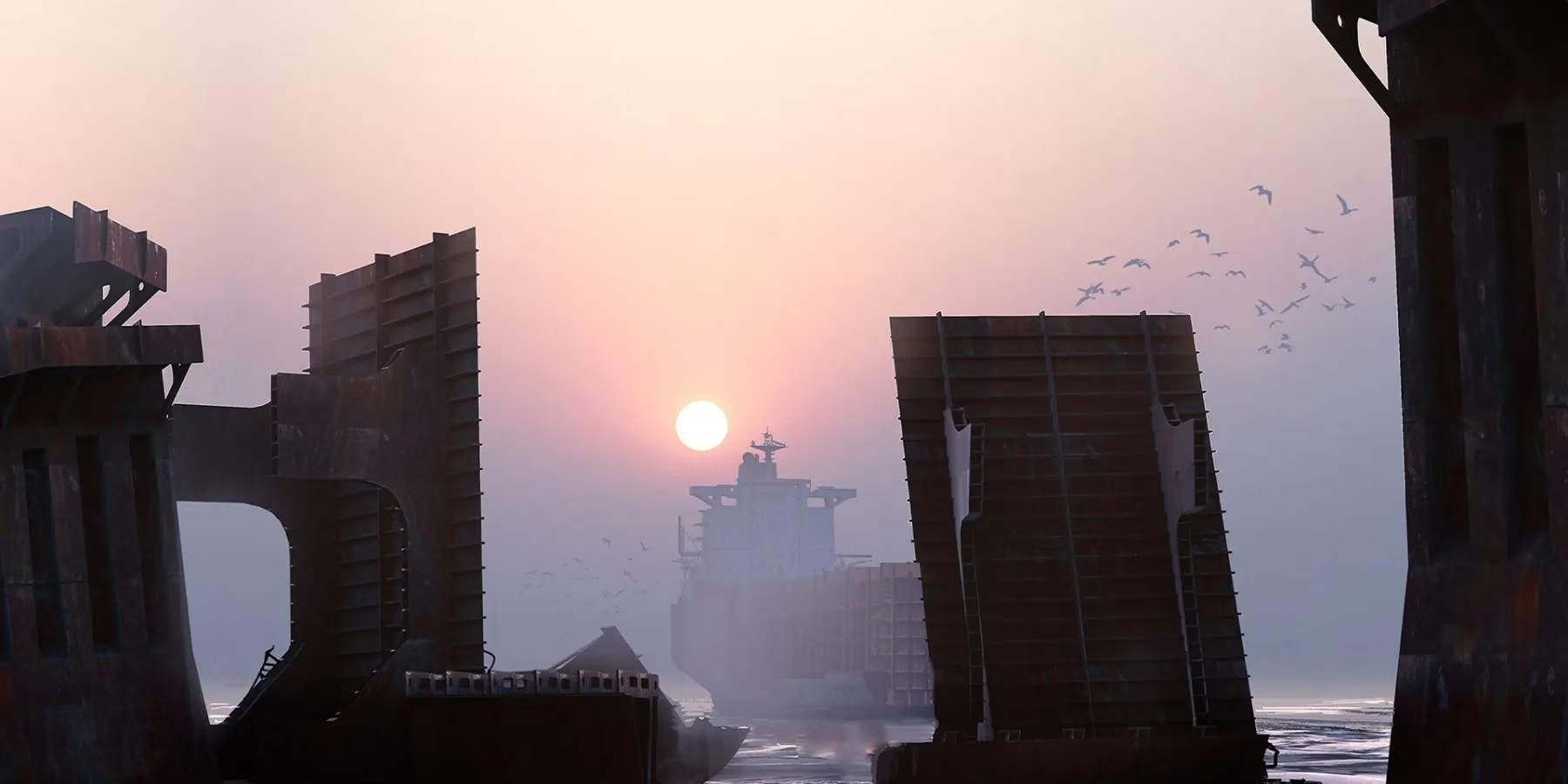
Discarded's smaller Conquest layout is a perfect example of better flow. It focuses combat around the main ship being disassembled, with consistent cover for infantry. There's still room for vehicles, but attackers and defenders can move from cover to cover. The larger version adds the northern half of the map, where the only meaningful cover is the buildings directly attached to objectives. Those indestructible boulders in the natural terrain are not as compelling as destructible buildings.
Manifest is perhaps the densest large map, but it has a different problem: shipping container bottlenecks. The containers create labyrinthine objectives, but they also force teams to bunch up around corners. The smaller Manifest cuts out much of the container-heavy section and shifts the focus to areas with actual buildings and more varied terrain. That change alone makes the map feel less like a series of chokepoints.
What Does This Tell Us?
So why do the 64-player maps feel better? Is it just the lower player count? Not exactly. It's the combination of smaller play areas and more deliberate cover placement. The 64-player variants often use the most crowded, interesting portions of each map. The 128-player versions, by contrast, stretch those same maps across too much open space.
| Map | 128-player issue | What the 64-player version shows |
|---|---|---|
| Breakaway | Too much empty glacier area | Workers' Village side is more focused |
| Hourglass | Empty sand, disconnected stadium | Shifting toward skyscrapers would help |
| Orbital | Split north/south, long empty routes | Cutting the southern half tightens flow |
| Discarded | Open northern half lacks cover | Ship area gives better infantry flow |
| Manifest | Shipping containers create bottlenecks | Cutting container-heavy section helps |
I'm not saying every map should simply be shrunk. But the 64-player layouts provide a clear direction for future reworks. Less empty space, more cover, and a tighter path between objectives would make 128-player matches feel faster without sacrificing scale.
Battlefield 2042 is a live-service game, so there is still room for map reworks. The rush of 128 players can be fantastic when the map supports it. But the 64-player variants are a reminder that scale alone doesn't make a battle great—good map design does.
As detailed in SteamDB, player-activity trends can quickly reveal whether a live-service shooter’s moment-to-moment pacing is landing with its audience—and Battlefield 2042’s ongoing mode rotations make that especially visible. When 64-player variants tighten objectives and reduce “dead travel” between fights, the resulting uptick in sustained engagement tends to align with what the gameplay experience suggests: less empty space and better infantry cover produce more continuous combat without needing to change the core 128-player fantasy.
Comments