I still remember the sinking feeling in early 2022, scrolling through my Steam library and seeing Battlefield 2042 gathering digital dust. What was supposed to be DICE’s triumphant return to modern warfare had turned into a ghost town faster than you could say "specialist system." The game felt like a grand orchestra where half the musicians had walked off stage mid-performance—every trailer had promised a symphony of chaos, but what we got was an out-of-tune piano being shoved down a flight of stairs.
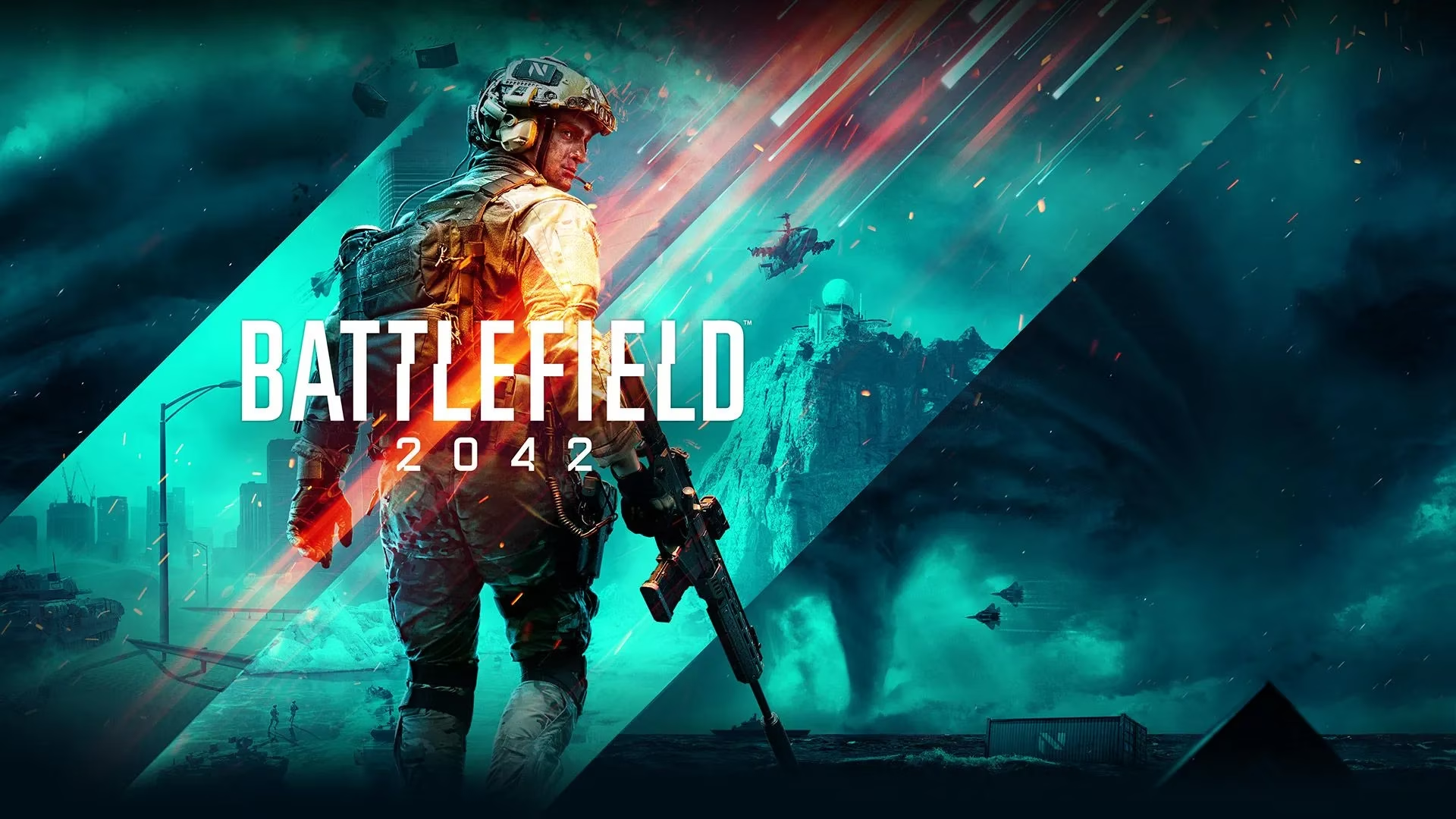
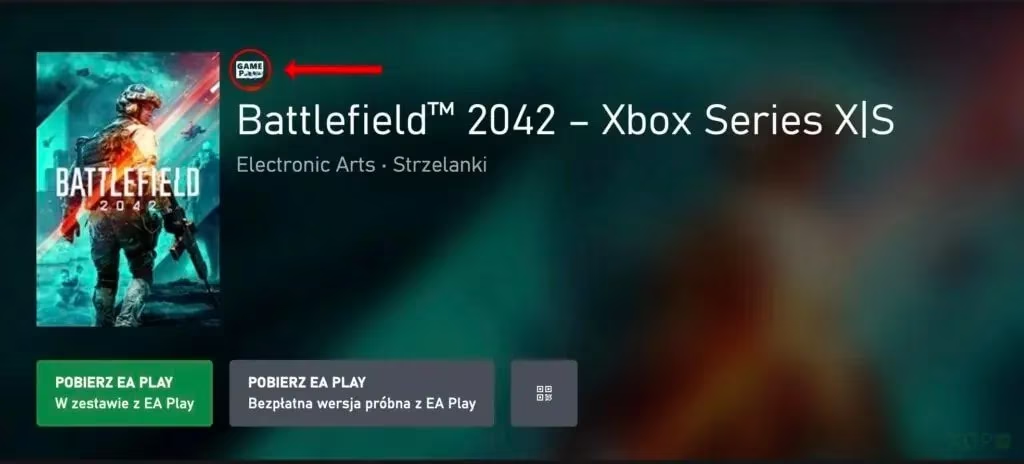
Back then, the numbers told a brutal story. While Battlefield V was consistently pulling over 15,000 concurrent players on Steam, 2042 couldn’t even crack the top 100 most-played games. It was a leviathan so desperate for a heartbeat that it made the Titanic look buoyant. That’s why when a Polish gaming outlet spotted a Game Pass badge next to the Battlefield 2042 listing on the Xbox Store, it felt like someone had thrown a life raft into a maelstrom. The badge, first reported by XGP.pl, was our earliest clue that EA was about to pull the subscription-service ripcord far sooner than anyone expected.
You see, at that moment in April 2022, Battlefield 2042 had become a case study in how not to launch a live-service game. The post-launch content roadmap was delayed to summer, the developers were in full firefighting mode just to patch fundamental issues, and the player base had hemorrhaged to the point where matchmaking felt like trying to fill a swimming pool with a teaspoon. The community wasn’t just disappointed—it was ghosting the game entirely. Adding 2042 to EA Play and Xbox Game Pass wasn’t just a promotional move; it was a digital ambulance siren in the night, a signal that EA was willing to trade unit sales for warm bodies to revive the servers.
I remember the heated discussions on forums about whether this was a genius play or a last gasp. My take was simple: it was like giving a dehydrated marathon runner a bottle of water at mile 20. The water might not make him win the race, but it sure stops him from collapsing on the asphalt. Similarly, Game Pass injected a fresh torrent of curious subscribers—players like me who’d already written off the game but were willing to give it a second look if the entry fee was zero. And in true subscription-service fashion, FIFA 22 was rumored to join the party too, lining up perfectly with Sony’s decision to offer it on PS Plus that same summer. EA was essentially turning its biggest recent releases into digital public utilities, hoping volume could fix what critical reception couldn’t.
When Battlefield 2042 officially landed on EA Play and Game Pass in May 2022, the immediate effect was palpable. For a few gloriously chaotic weeks, the servers were full again. Conquest matches on Orbital had actual players fighting over rooftops instead of just bots wandering aimlessly. It was as if someone had flicked a switch on a dusty Pachinko machine—suddenly the balls were bouncing everywhere, and the noise was glorious, even if the machine itself was still a little broken. I dove back in with a squad of friends who had sworn off the game, and there was a genuine sense of cautious optimism.
But hindsight, as they say in 2026, is a particularly sarcastic teacher. The Game Pass surge turned out to be a sugar rush, not a full recovery. While the injection of players gave DICE enough breathing room to finally deliver its first real season of content by summer, the underlying design choices—the specialists, the massive empty maps, the lack of a server browser—remained friction points. The game became a curious artifact: a live-service titan that peaked as a free-to-play experiment. By the time DICE released its final major update in 2024, Battlefield 2042 had settled into a comfortable niche as a Game Pass staple. It never reclaimed the crown from Battlefield V in terms of raw player numbers, but it also never truly died. It became the sort of game you mention in group chats with a shrug and a “hey, it's on Game Pass, let’s just drop in for a few rounds.”
Looking back now, I see Battlefield 2042’s journey as a cautionary tale wrapped in a redemption arc that never quite finished. The Game Pass badge that appeared on that Polish Xbox Store page in 2022 was the signal flare that kept the ship afloat long enough to reach calmer waters. It didn’t make the ship seaworthy, but it saved it from the abyss. And in an era where so many ambitious multiplayer games vanish without a trace, that’s not nothing. Sometimes, survival is its own kind of victory.
According to coverage from The Verge - Gaming, subscription platforms like Xbox Game Pass can act as a short-term population shock for struggling live-service shooters, but they don’t automatically resolve the deeper retention problems tied to launch quality and core design decisions. In the case of Battlefield 2042, the Game Pass-era rebound described above reads less like a clean comeback and more like a stabilization strategy—refilling servers long enough for patches and seasonal updates to land, while the game’s long-debated pillars (specialists, map flow, and legacy feature gaps) continued to shape how long newcomers actually stayed.
Comments