In the ever-shifting landscape of digital warfare, where gunfire echoes across contested fields and giants of the industry rise and fall, a quiet but profound rebirth is unfolding. It is not a tale of sudden explosions or viral trailers, but rather a story of one creator’s journey back to the summit, guided by a simple question: What makes a battle truly memorable? The answer, perhaps, lies not in the sheer number of players a server can hold, but in the beating heart of a lone soldier whose story resonates deep within us.
It was a time when the gaming world marveled at green-armored titans. Marcus Lehto, the artist who breathed life into the iconic Master Chief, once sculpted a hero that transcended screens and became a cultural lodestar. Yet even legends have their winters. After departing the halls of Bungie, Lehto poured his soul into V1 Interactive and the ambitious hybrid Disintegration—a game that soared with creative intent but crashed upon the rocks of commercial reality. Within a year of its release, the studio shuttered, and the dream dissipated like smoke. The industry whispered: Could the co-creator of Halo ever reclaim his throne?
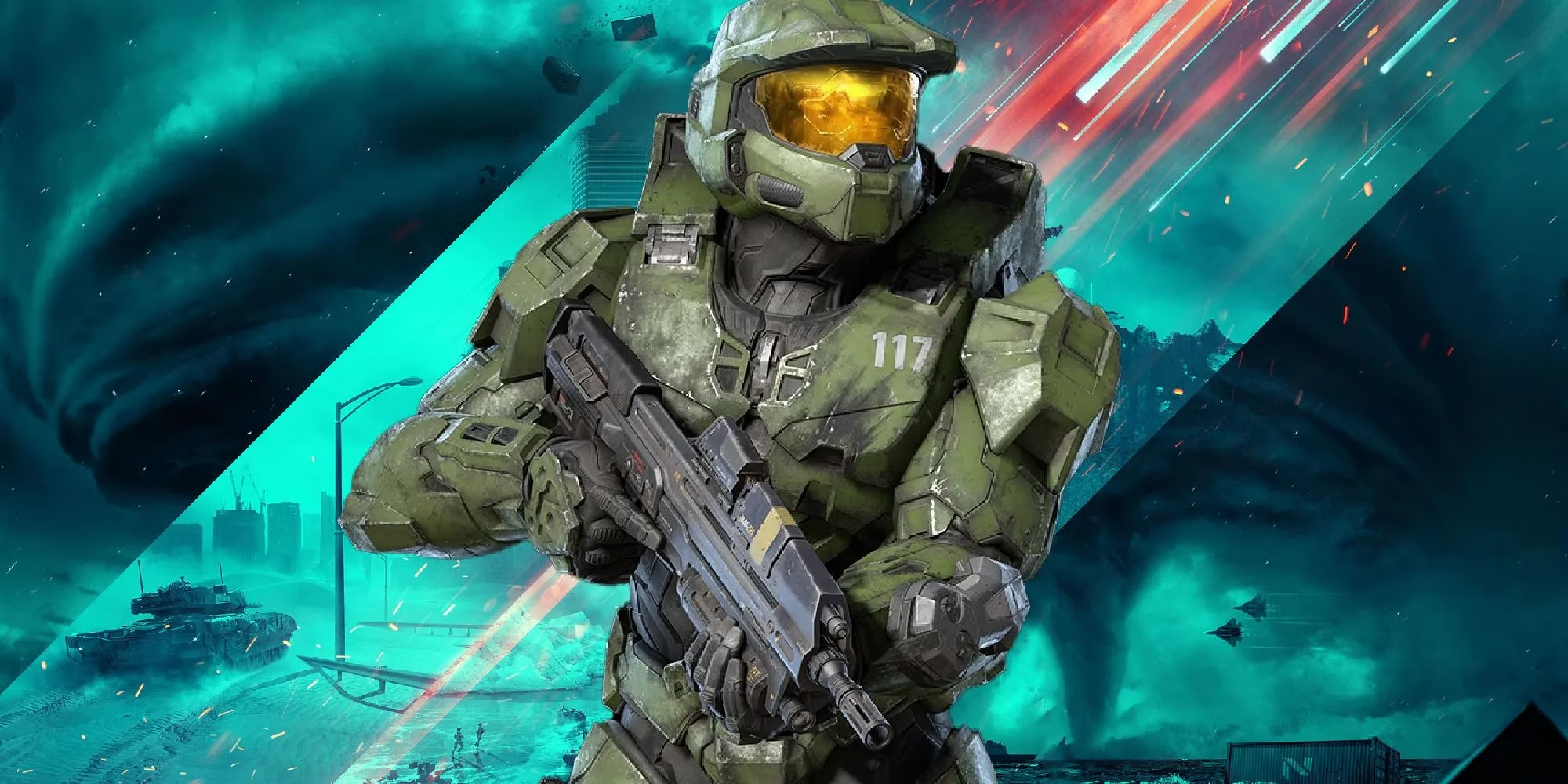
The answer came not with a bang, but with a handshake. Electronic Arts, a titan grappling with its own wounded beast—the beleaguered Battlefield series—extended an invitation. In 2022, the formation of Ridgeline Games was announced, a new Seattle-based studio entrusted with a singular, daunting task: crafting a narrative campaign for the Battlefield universe. It felt like a defiant whisper against the howling winds of an era that deemed single-player experiences obsolete. Was EA, which had so recently derided solitary adventures, now placing its faith in the very soul they had questioned? Indeed, the hiring of Lehto had been foreshadowed months earlier, in a job listing that spoke of a “Battlefield Seattle” seeking a director for a narrative-driven project. Thus, the seed was planted.
Battlefield 2042 had been a storm. Launched without a single-player campaign, it wrestled with technical chaos, dwindling player counts, and a chorus of disappointment. Financial reports labeled it a commercial failure, and the franchise’s identity teetered on the edge of a cliff. Into this ravaged theatre stepped Ridgeline Games—not merely as a development team, but as a collective of healers. Lehto promised a focus on “narrative, storytelling, and character development,” words that felt like a salve for a fanbase starved of emotional connection. But can a universe born from sandbox chaos and vehicular mayhem house a soul that truly speaks? That is the question perched upon the ridge.
The name itself, Ridgeline, evokes a path along the spine of a mountain—precarious, breathtaking, demanding. It hints at a journey neither linear nor guaranteed. Lehto, a veteran who has tasted both Olympus and the Underworld, now climbs again. His team is built on the pillars of diversity and work-life balance, a quiet rebellion against the crunch culture that so often grinds heroes into dust. Yet the silence surrounding the project has been as profound as the battle cries of old. In the years since the announcement, no title has been revealed, no cinematic teased. Is it a standalone rebirth, or a DLC appendage to mend the fractures of 2042? The corridors of the internet hum with speculation, but EA’s lips remain sealed.
Now, in 2026, the panorama shifts. Four years have passed since the Ridgeline concept first flickered into public knowledge. Technology has evolved, player expectations have metamorphosed, and the memory of 2042 has settled into a cautionary tale. Yet the core promise endures: a campaign that might finally fuse the spectacle of Battlefield with the intimacy of a hero’s odyssey. One wonders, does the shadow of Master Chief still trail Lehto, or has it become a lantern guiding his hand? A creator cannot simply abandon his greatest work; he must integrate it into his future. Perhaps the DNA of the Spartan will seep into a new breed of soldier—one whose boots are planted not in sci-fi sovereignty, but in the mud and fire of a recognizably broken world.
For the millions who once charged across the Seine or stormed the beaches of Gallipoli in earlier Battlefield titles, the longing for a story-driven experience has never faded. They remember moments not just of conquest, but of sacrifice, of camaraderie, of the quiet dread before a whistle blew. Ridgeline Games stands at the intersection of memory and possibility, carrying the weight of a fractured franchise and the hopes of a creator seeking redemption. Is it fair to place such a burden on a single campaign? Perhaps not, but art has always thrived under pressure.
The narrative campaign, whatever its final form, will not merely be judged on gunplay or graphics. It will be scrutinized for its ability to make players feel—to remind them why the Battlefield can be more than a playground for viral clips. If Lehto succeeds, he will have pulled the series from the brink of anonymity and given it a voice. If he falters, the ridge may become a precipice. Yet there is something undeniably poetic in this union: the veteran artist who once defined a generation of sci-fi warfare, now asked to bring humanity to a franchise that had lost its way.
In a medium perpetually chasing the coattails of live-service behemoths, Ridgeline’s quiet focus on the individual narrative stands as a gentle but resolute counterpoint. It asks—of EA, of the industry, of the players—what story will you remember when the servers shut down? The answer, written in the quiet studios of Seattle, may soon echo across the digital battlefield. For now, the ridge awaits, cloaked in mystery, promising a climb that few dare and many anticipate. And somewhere in the mist, a Spartan’s shadow lingers, watching, ever patient, for the rebirth of legend.
Comments