It was a move that felt like a Hail Mary pass from a quarterback under pressure. Back in November 2022, Electronic Arts confirmed in a development update that Battlefield 2042 was finally heading to Xbox Game Pass Ultimate and EA Access. At that moment, the shooter was still licking its wounds from one of the most notoriously disastrous launches in modern gaming history. Fast forward to 2026, and industry analysts now point to that very day as the inflection point where the tide began to turn—not just for the game, but for the entire Battlefield franchise.
The story of Battlefield 2042's resurgence is a classic \u201cphoenix rising from the ashes\u201d tale. When the game launched in late 2021, it was met with a firestorm of criticism. Missing features, technical bugs, and controversial design choices like the Specialist system drove players away in droves. DICE was forced to slam the brakes on its post-launch content roadmap, effectively reworking the core experience before any meaningful seasonal drops could arrive. The summer of 2022 finally brought Season 1, and while it was a step in the right direction, the player count needed a serious shot in the arm. Enter Game Pass.
The November 2022 announcement wasn\u2019t just about a subscription service addition. EA paired it with the reveal of Season 3\u2014a colossal update that would reintroduce the class system, a long-requested feature reminiscent of earlier Battlefield titles that sent the community into a frenzy of hype. Each Specialist was reorganized into one of four distinct roles, granting them access to specialized gadget pools, equipment, and weapon proficiencies. This wasn\u2019t a minor tweak; it was a fundamental overhaul that brought back the rock-paper-scissors squad dynamics veterans had been begging for. The update also teased the return of the fan-favorite XM8 and A-91 weapons, plus a new unannounced Specialist who would shake up team compositions.
But perhaps the biggest ace up EA\u2019s sleeve was the map rework initiative that Season 3 accelerated. Manifest and Breakaway received major overhauls aimed at improving gameplay flow. On Manifest, HQ flags were pulled closer to the action, redundant play spaces were axed, and lighting got a massive visibility boost. Breakaway saw its Oil Rig shifted to reduce downtime, the irrelevant Outpost flag was cut entirely, and town layouts were revamped with better shaders and sightlines. These weren\u2019t mere cosmetic touch-ups; they were surgical strikes on the game\u2019s most frustrating choke points.
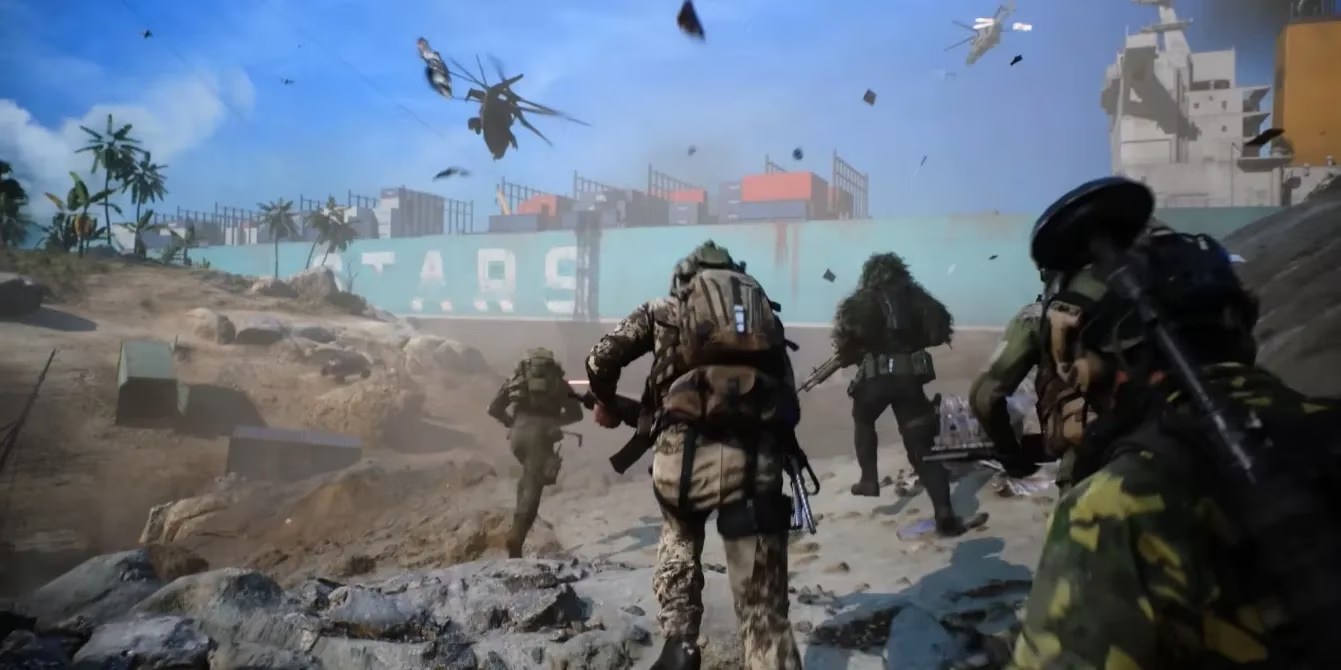
Coinciding with the Game Pass drop, EA also rolled out free access periods in December 2022, letting PlayStation fans and fence-sitters test the waters for a limited time. The result was an immediate surge in player numbers. Steam Charts began painting a much healthier picture, and social media sentiment shifted from \u201cdead game\u201d memes to genuine clips of squads pulling off insane rendezooks. It was the \u201ctold you so\u201d moment DICE desperately needed.
From a 2026 vantage point, we can see that this wasn\u2019t just a temporary bump. The Game Pass infusion gave Battlefield 2042 something it had lacked: a vibrant second-chance ecosystem. New players poured in, discovered a game that had been patched into a genuinely fun state, and stuck around. The class system rework created deeper meta-strategies, and Season 4 onward built on that foundation with tighter maps, cross-faction storytelling, and a Portal mode that finally delivered on its promise of persistent servers and wacky custom game types.
By mid-2024, Battlefield 2042 had completed its redemption arc. The concurrent player counts were not only stable but at times rivaling the franchise\u2019s peak entries. The game became a mainstay on Xbox Game Pass, with each new season treated as a mini-event that drew back lapsed Battlefield fans. DICE managed to pull off what many thought impossible: turning a game that had been written off as a failure into a live-service success story. The morale boost within the studio was palpable, leading to more audacious updates\u2014weather events that dynamically reshaped maps, Portal creations that mimicked historic battles, and a Specialist origin series that added narrative weight without compromising the sandbox freedom.
The long tail of this revival also influenced EA\u2019s broader strategy. Seeing firsthand how a subscription platform could resurrect a title, EA doubled down on day-one Game Pass releases for subsequent entries in the series. The Battlefield franchise learned that launch windows are no longer the be-all and end-all; a game\u2019s lifespan is now measured in years, not weeks. And let\u2019s be real\u2014it was a gutsy move to invite millions of new players into a game that had been a punching bag for months. As the old saying goes, \u201cYou only get one chance to make a second first impression,\u201d and Battlefield 2042 seized it.
Today, in 2026, the shooter continues to receive seasonal content, although at a more relaxed cadence as the community patiently awaits word on the next franchise installment. \u201c2042\u201d has become a sort of digital hangout spot\u2014a place where newbies and veterans alike squad up, knowing the maps like the back of their hands, still finding new ways to launch a jeep off a skyscraper. The game\u2019s journey from zero to hero is a cautionary tale for developers everywhere: shipping a broken product is never ideal, but humbly fixing it and using platform reach to reset the narrative can pay off in spades. No cap, as the kids say, DICE pulled off one of gaming\u2019s greatest comebacks.
As we look forward to what\u2019s next, the shadow of Battlefield 2042's rehabilitation looms large. It proves that a dedicated studio, combined with smart business moves like Game Pass integration, can turn the ship around even when the world has written it off. And for the millions of players still parachuting into Hourglass or sniping across Exposure, that late-2022 decision was the ultimate game-changer.
Comments