As I sit here in 2026, controller in hand, I can't help but feel the tectonic plates of the FPS landscape shifting beneath my feet. For as long as I can remember, the rivalry between Battlefield and Call of Duty has been the defining saga of my gaming life—a constant, thrilling tug-of-war for my attention. The last few years, however, have told a different story. While Call of Duty: Black Ops 6 soared, Battlefield 2042... well, let's just say it stumbled out of the gate. The competition isn't just fierce now; it's existential. And as a long-time fan of sprawling battles and collapsing buildings, my hope rests on DICE learning not from their own past, but from their rival's boldest recent success. The blueprint for Battlefield's redemption might just be hidden in the Iraqi desert of Black Ops 6's 'Hunting Season'.
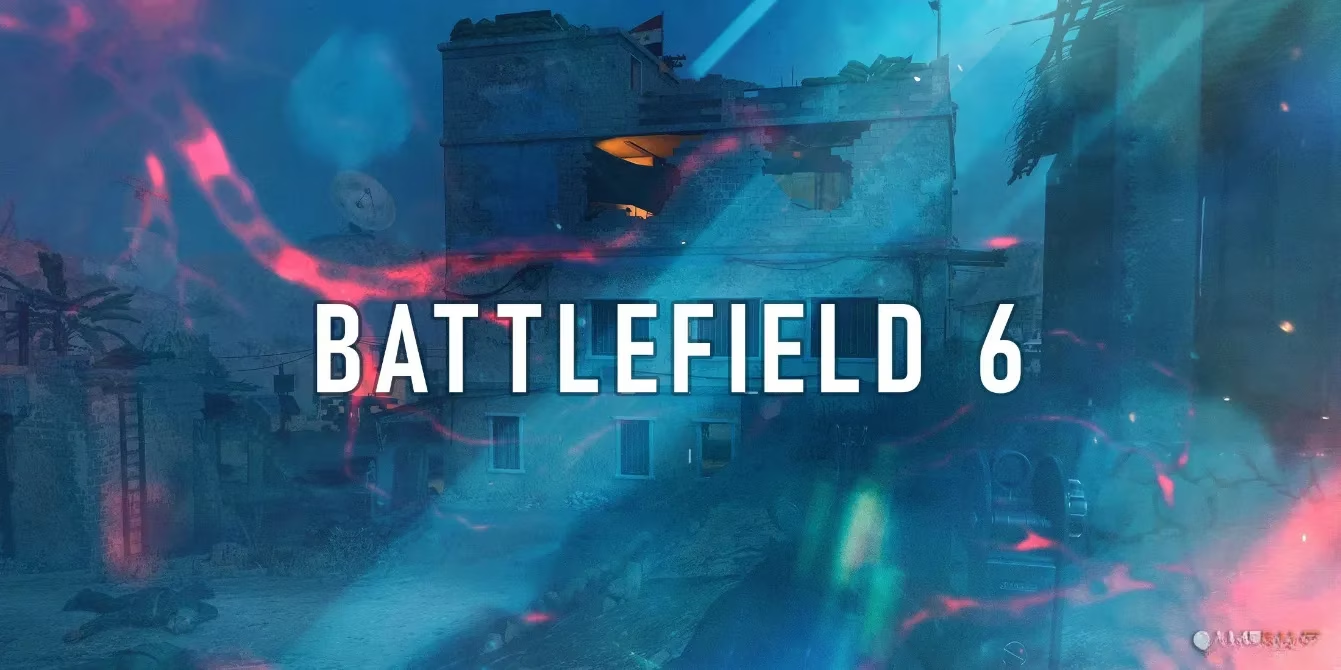
The 'Hunting Season' Revelation: A Game-Changer in Disguise
I remember booting up 'Hunting Season' for the first time. Most of Black Ops 6's campaign played it safe—tense corridors, scripted set-pieces, the usual CoD magic. But this mission? Man, it was a different beast entirely. Treyarch and Raven Software basically handed me the keys to a vast, sun-bleached playground and said, 'Figure it out.' The primary goal—destroy three Scud launchers—was just the starting line. From there, I was free to:
-
🗺️ Explore the map at my own pace, uncovering hidden caches and enemy patrols.
-
⚔️ Tackle objectives in any order I fancied, creating my own narrative of the assault.
-
🎯 Discover secret side missions that felt organic, not like checklist chores.
It was Call of Duty's most convincing flirtation with open-world design yet, and it left a mark. The mission proved that linear, cinematic storytelling and player agency aren't mutually exclusive. It created a unique, memorable experience that fans are still talking about. And honestly? It felt less like a CoD mission and more like a... well, a Battlefield fantasy waiting to happen.
Why This Is Battlefield's Perfect Playbook
Here's the thing—Battlefield has been doing 'big' for decades. Its identity is built on colossal maps where the environment is as much a character as the soldiers. We don't just fight on the map; we fight with it. We level buildings to flush out snipers, crater roads to halt advancing armor, and turn city squares into dust-filled arenas. The core gameplay loop is already one of emergent, large-scale chaos.
| Call of Duty's 'Hunting Season' | Battlefield's Natural Advantage |
|---|---|
| A contained, mission-based open zone. | A legacy of truly massive, multi-objective maps. |
| Scripted destruction events. | A fully realized, systemic destruction engine. |
| Vehicle use as a tool for traversal. | Vehicles as core, class-defining gameplay pillars. |
| A novel experiment for the franchise. | A foundational philosophy waiting for this application. |
DICE doesn't need to reinvent the wheel; they just need to point their own glorious, chaos-creating machine in a new direction. Imagine dropping into a single-player campaign mission set in a war-torn European city or a vast Pacific archipelago. Your main objective is to sabotage a key communications hub. But the journey there? That's where the magic happens.
You could commandeer a tank and blast a new path through a city block, stumble upon a squad of trapped allies who need extraction, or use a drone to spot and mark artillery positions for an off-map strike—all while the core battle rages dynamically around you. The tools, the scale, and the 'everything can be destroyed' ethos are already in Battlefield's DNA. 'Hunting Season' proved the concept works; Battlefield has the raw materials to build a cathedral out of it.
The Path Forward: Building an Unforgettable Campaign
After the missteps of 2042, the next Battlefield needs a knockout punch. A campaign built on this 'open sandbox' philosophy could be exactly that. It wouldn't just be about copying CoD; it'd be about taking the best idea their rival has had in years and executing it on a scale only Battlefield can.
The potential mission structure could look like this:
-
The Drop: Insert into a massive, active warzone with a primary strategic goal (e.g., 'Assassinate the enemy general,' 'Secure the harbor').
-
The Sandbox: The entire map is your toolset. Need to flank a fortress? Blow a hole in the seawall and swim around. Need to create a diversion? Topple a radio tower onto an enemy convoy.
-
Emergent Story: The narrative isn't just in cutscenes. It's in the desperate defense of a captured checkpoint you stumbled upon, or in the Intel you find in a ruined building that changes your primary objective.
-
Signature Chaos: All while 64-player-scale AI battles rage, with factions dynamically attacking and defending points, making the world feel truly alive.
This approach plays to every one of Battlefield's historic strengths while embracing a modern, player-driven design. It would create those 'you had to be there' stories that define the best multiplayer matches, but within a crafted, cinematic single-player experience.
A Rivalry That Makes Us All Winners
Look, I love a good rivalry. It pushes everyone to be better. Black Ops 6 didn't just release a great game; it threw down a creative gauntlet with 'Hunting Season.' For Battlefield, the response shouldn't be to shy away from that challenge. It should be to look at that idea and say, 'Hold my beer.'
By fusing CoD's mission-based open-world concept with Battlefield's unparalleled sense of scale and destruction, DICE could create something genuinely groundbreaking. It would be a campaign that doesn't just tell a war story but lets you live your own within it. In 2026, that's the kind of bold swing the franchise needs. It's time for Battlefield to stop playing catch-up and start playing by its own, world-shattering rules. The hunting season for redemption is open, and the perfect blueprint is already on the table.
Comments