It’s 2026, yet the sting of Battlefield 2042’s release still resonates in the gaming community. I remember watching the hype train barrel forward, only to derail spectacularly after launch. Back then, fans and even EA acknowledged the game as a colossal letdown. Now, years later, I find myself revisiting a pivotal moment when David Goldfarb—the lead designer of the beloved Battlefield 3 and Bad Company 2—broke his silence and put into words what so many of us were feeling. His critique wasn’t just a rant; it was a masterclass in identifying where a beloved franchise lost its way.
I have to ask: how did a studio with DICE’s pedigree ship a game missing basic infantry-focused maps? That was Goldfarb’s first target. He couldn’t wrap his head around the absence of smaller, tightly designed arenas where boots-on-the-ground combat shines. Even more baffling was the 128-player count. On paper, that number sounds epic. But without proper infantry accommodations—cover, flow, logical spawn points—it often turned into a chaotic, soulless meat grinder. Had anyone really tested whether massive lobbies enhanced the classic Battlefield sandbox, or did marketing demands overrule common sense?
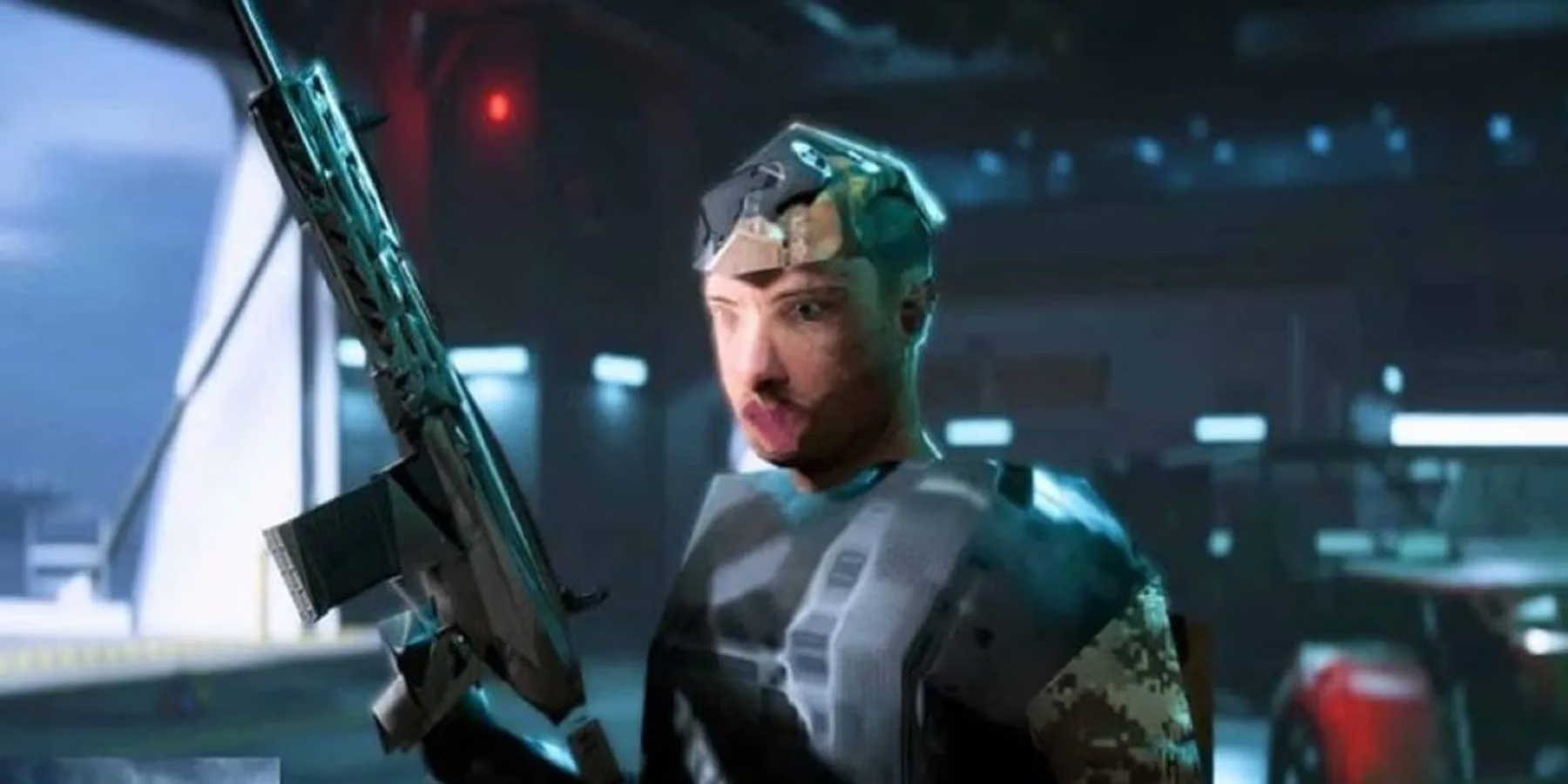
Then came the visual quality. Goldfarb questioned why maps shipped without detailed art, openly wondering if quality control even had a seat at the table. I recall loading into Hourglass for the first time and feeling like I’d stepped into an early-access title, not a premium $70 release. The sterile environments and jarring glitches (like the famous spaghetti-limbed soldier shown above) told a story of a project rushed out the door. In his series of tweets, Goldfarb admitted he expected obstacles from executives, but he never imagined someone would greenlight a product that failed so thoroughly to honor the franchise’s combined-arms legacy.
And yet, he didn’t just hurl criticism. What struck me most was his empathy for the developers. Having been in the trenches himself, he knew the talent at DICE. He was genuinely happy to see Bad Company 2 and Battlefield 3 resurrected through Portal mode. I have to agree—Portal was a brilliant lifeline. It gave us a way to relive classic experiences while the main game floundered. But did that niche mode justify the broader disaster? Judging by the petition that gathered thousands of signatures demanding refunds across all platforms, the answer was a resounding no. Players felt betrayed, and their wallets screamed as loudly as their voices.
Let’s fast-forward to 2026. Did anyone listen to Goldfarb’s recommendation to push the franchise even further into the future—perhaps to 2143? Not exactly. EA and DICE tried to salvage 2042 with a parade of updates: new maps, specialists reworks, and eventually the return of traditional classes. I watched the player count flicker back to life sporadically, especially after the game hit Game Pass and experimented with free-to-play weekends. But the damage was done. The “combined-arms badassery” Goldfarb described as the series’ soul never fully returned. By late 2024, active development on 2042 ceased. The focus shifted entirely to the next mainline Battlefield, which rumors suggest is a connected-universe reboot.
Looking back, I can’t help but wonder: was Battlefield 2042 ever truly fixable? In my opinion, the core design choices—the enormous, sterile maps, the cringe-worthy specialists, the abandonment of the squad dynamic—were fundamental. Iterative patches could smooth rough edges, but they couldn’t replace a flawed foundation. Goldfarb saw it immediately. He didn’t need months of data; he just watched footage and played the game on February 7, 2022, and instantly diagnosed the rot. That’s the instinct of someone who understood why Battlefield used to be special.
Interestingly, his critique also served as an unintended prophecy. The “higher-ups” he mentioned likely pressured the team to chase trends: larger player counts, hero-shooter abilities, and a live-service skeleton. Sound familiar? In 2026, we’re seeing studios slowly retreat from these very mistakes, but back in 2021 and 2022, the industry was convinced that every game needed to be a forever platform. Battlefield 2042 became a cautionary tale taught in game design post-mortems—a textbook example of losing your identity while trying to please everyone.
So where does that leave the franchise? Goldfarb’s vision of a 2143 title never materialized, but the community’s hunger for a true sci-fi Battlefield hasn’t faded. Leaks suggest the upcoming entry might blend modern and near-future settings. I’m skeptical. What I really want, as a player, is for DICE to go back to the drawing board and ask themselves the very questions Goldfarb posed: Who is in charge of quality? Does every design choice serve the sandbox of infantry, vehicles, and destruction? And most importantly, does this feel like “Battlefield”? Those questions are timeless, and in 2026, they remain the only path to redemption.
Ironically, Battlefield 2042 is still playable today. The servers aren’t dead, and a modest community clings to Portal creations. But its legacy is a scar, not a monument. Every time I launch the game, I see the ghost of what could have been. Goldfarb’s tweets from 2022 echo louder than ever now that the dust has settled. His final plea—to recapture the IP’s unique appeal—hangs in the air, unanswered. As we stand on the cusp of a new Battlefield reveal, I can only hope someone at the studio has those words framed on their wall.
What about you? Do you still play 2042, or have you moved on? Are Goldfarb’s criticisms still valid in 2026, or did the live-service turnaround convince you otherwise? I suspect the answers split along the same fault lines that fractured the community at launch. One thing is certain: in an industry that too often forgets its history, this messy chapter deserves to be remembered—not with bitterness, but as a lesson. A lesson that quality, identity, and respecting your players will always outweigh chasing the next big trend. And if I’m being brutally honest, Battlefield 2042 taught us that lesson the hard way.
Comments